
Chemical Spill Response Training in Saudi Arabia
A split drum or a failed transfer hose gives you a few minutes to get things right. What your people
do in those minutes decides whether you end the day with a cleanup or an incident report.
What Is Chemical Spill Response?
Chemical spill response covers everything a workplace does once a hazardous chemical escapes its container: recognising the danger, protecting people, stopping the release, containing it, cleaning up and reporting. Handled well, a leak stays a minor event. Handled badly, it turns into a fire, a poisoning or an environmental case.
Our chemical spill response training teaches that sequence for Saudi workplaces such as plants, labs, warehouses, workshops, hospitals and project sites. It is a hazardous chemical spill response course built around how chemicals behave, what the Safety Data Sheet tells you, and when to act yourself rather than call for help. It takes 3 to 4 hours, online or at your facility, and ends with a TVTC accredited certificate.
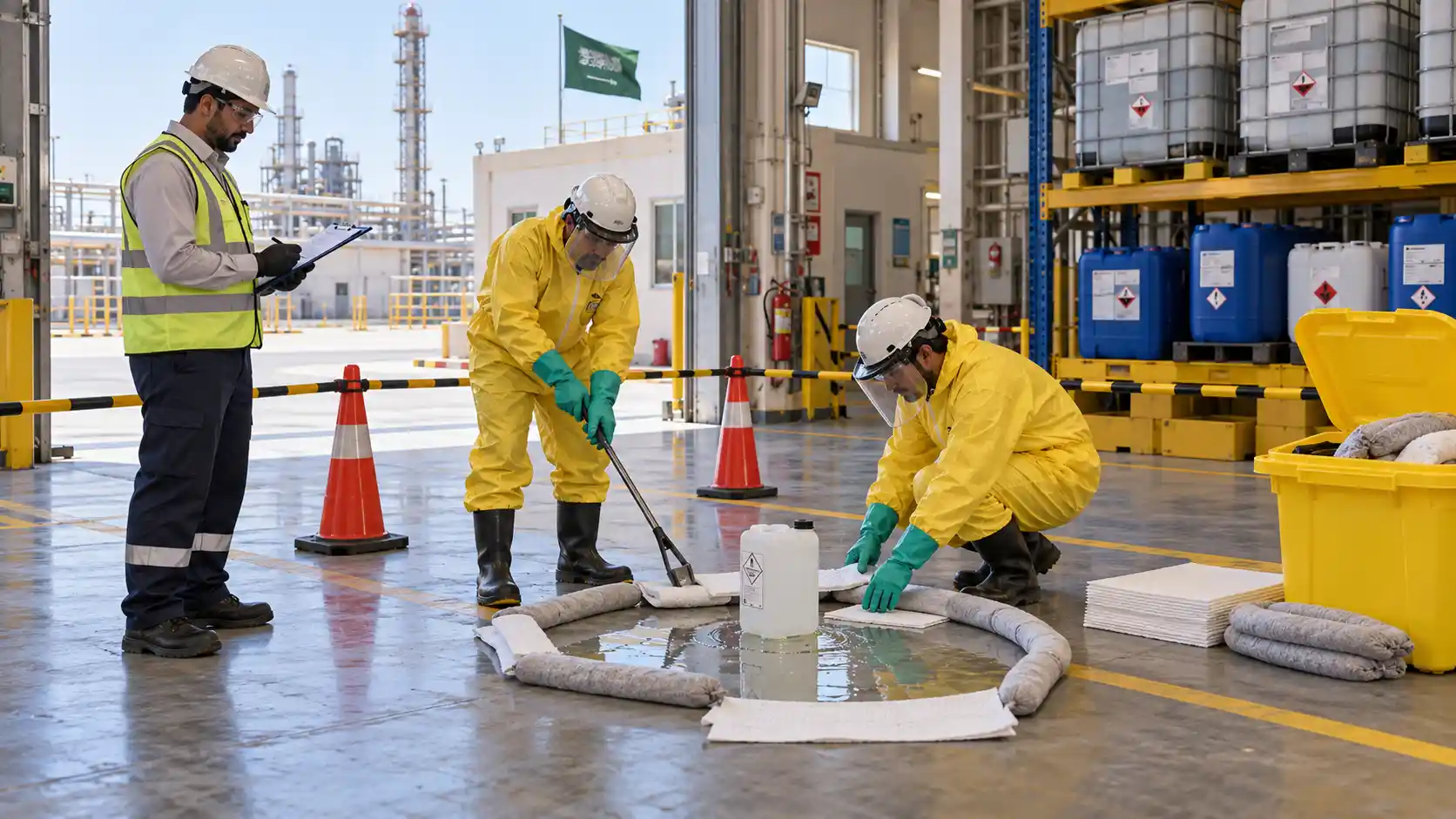
Simple Spill vs Complex Spill
Not every spill is yours to clean. A simple spill is small, the chemical is known, nothing has reached a drain, and trained staff have the right PPE and spill kit at hand. Your own people can deal with it. A complex spill is a different matter: a large volume, an unknown or highly toxic chemical, fire risk, injured people, or a release into drains, soil or water. That calls for emergency help, meaning your emergency response team (ERT) and Saudi Civil Defense once the situation goes beyond them.
The course trains people to make that call quickly, based on quantity, location, chemical properties and who is available. One rule runs through every session: if in doubt, treat it as complex.
Who Should Attend
Anyone who works with chemicals or could be first on the scene:
- ERT members, ERT leaders and on-scene incident commanders
- Hazmat team members, hazmat technicians and spill responders
- HSE managers, EHS coordinators and chemical safety officers
- Plant managers plus operations and maintenance supervisors
- Warehouse personnel and transportation workers who move drums and tankers
- Environmental technicians, industrial hygienists and laboratory staff
- Hospital and facility maintenance teams
- Fire fighting and first aid team members who back up the response
The 7 Steps of Chemical Spill Response
Some providers teach 5 steps of spill response, others teach 7. We use seven because they keep protection and reporting as separate steps. The first step in a spill response is always to assess, never to reach for the absorbent, and that is the correct order every time:
- Assess and identify: what the chemical is, how much has escaped and where it is heading. Read the label and SDS, and look for fire, vapour or reactivity risk.
- Alert and protect: warn people nearby, evacuate if needed, set an exclusion zone and put on the right PPE.
- Stop the source: close a valve, stand a container upright or plug a leak, but only if it is safe.
- Contain: cover drains and ring the spill with socks, booms or dikes before it reaches soil or water.
- Clean up: absorb or neutralise as the SDS directs, working from the edge inward.
- Decontaminate and dispose: clean people and equipment, then bag and label the waste as hazardous.
- Report and restock: record what happened, find the root cause and refill the spill kit.
Safety note: only trained, properly equipped responders carry out steps 3 to 7. Everyone else evacuates, raises the alert and reports. These chemical spill response steps are taught as course content, not as a do-it-yourself cleanup guide.
Certificate, Validity and Verification
Complete the course and you receive a TVTC accredited certificate, valid for 2 years. It carries a unique number in the format FVCAT-26-149967, and any employer can enter that number on our certificate verification page to confirm it. Before it expires, a short refresher renews it, so there is no need to repeat the full course.
Chemical Spill Response Training Across Saudi Arabia
Train online from any city, or we come to your plant, warehouse, hospital or project site anywhere in the Kingdom. On site, people learn with your own drains, storage areas and spill kits around them. We cover the Eastern Province from our Al Khobar base and travel to Riyadh, Jeddah, Jubail, Yanbu and remote industrial sites. Classes run in Arabic, English, Hindi and Urdu. Looking for chemical spill response training near me? Wherever your site is, we can reach it.
Saudi Standards Covered
The course follows the Kingdom’s own framework for chemicals at work and pollution:
- Saudi Environment Law (Royal Decree M/165, 2020): bans pollution of air, land and water. Compliance is enforced by the National Center for Environmental Compliance (NCEC), part of the Ministry of Environment, Water and Agriculture (MEWA).
- Marine pollution penalties: damaging the marine environment can bring up to 10 years in prison and fines of up to SR30 million, which matters for sites near the coast.
- Saudi Labor Law, Chapter 8: employers must explain hazards before work starts, supply PPE free of charge, train workers to use it, post safety instructions in Arabic and other languages workers understand, and keep first aid supplies ready.
- Saudi Civil Defense: when and how to escalate a spill that is beyond your team, and fire precautions for flammable chemicals.
Spill Responder Jobs and Team Roles
Most Saudi industrial sites need named people on their chemical spill response team, not just a spill kit on the wall. The certificate supports roles such as spill responder, hazmat team member, ERT member and chemical safety officer. It also helps warehouse, maintenance and environmental staff move into safety roles. Chemical plants, logistics and storage operators, hospitals, contractors and environmental cleanup specialists all build a chemical spill emergency response team. Crews that handle flammables often add fire watch training and first aid training.