
Excavator Safety Training in Saudi Arabia
Most excavator incidents don’t start with a lack of skill on the controls. They start with a missed check, a worker inside the
swing radius or a bucket too close to a buried cable. This course deals with exactly those moments.
What Is Excavator Safety Training?
Excavator safety training teaches operators and the people around them how to keep an excavator from hurting anyone. It covers the daily walkaround, safe start-up and shutdown, stability on slopes and soft ground, digging near services, lifting loads, and the signals that keep the operator and the ground crew in step.
Our course is built for Saudi sites: construction projects, oil and gas facilities, quarries and municipal works, where heat, dust and tight access add to the risk. It is safety knowledge, delivered in 3 to 4 hours at our institute and at your location, and it ends with a TVTC approved certificate. Think of it as the classroom half of excavator operator training, the part that explains why each rule exists.
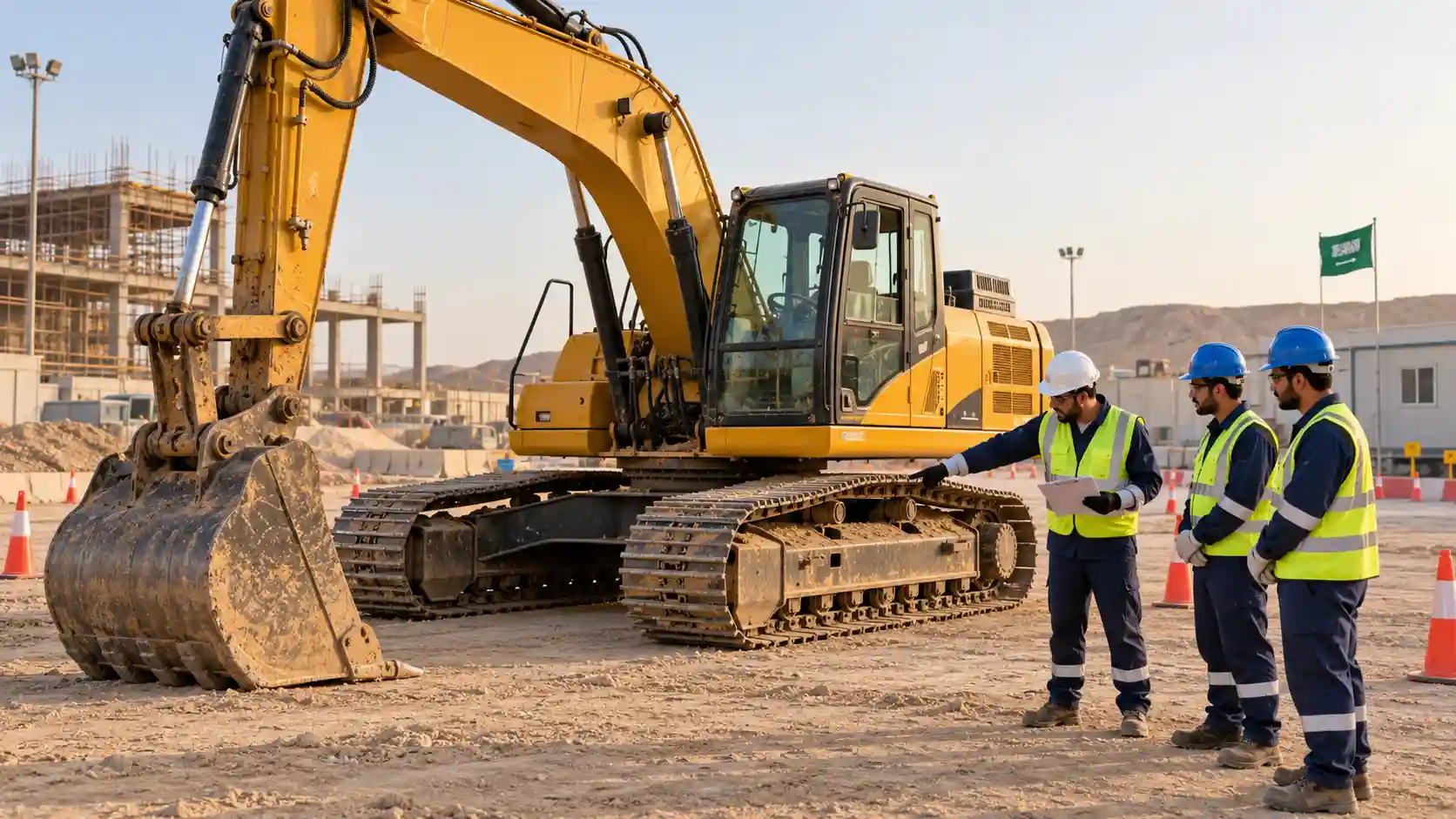
Excavator Safety vs Excavation Safety
These are two different courses. Excavation safety is about the hole: trenching, shoring, soil types and protective systems that stop a trench wall collapsing on workers. Excavator safety is about the machine: inspecting it, operating it safely and keeping people clear of it. This page covers the machine. Trench hazards come up only where they affect the operator, such as keeping the machine back from the edge.
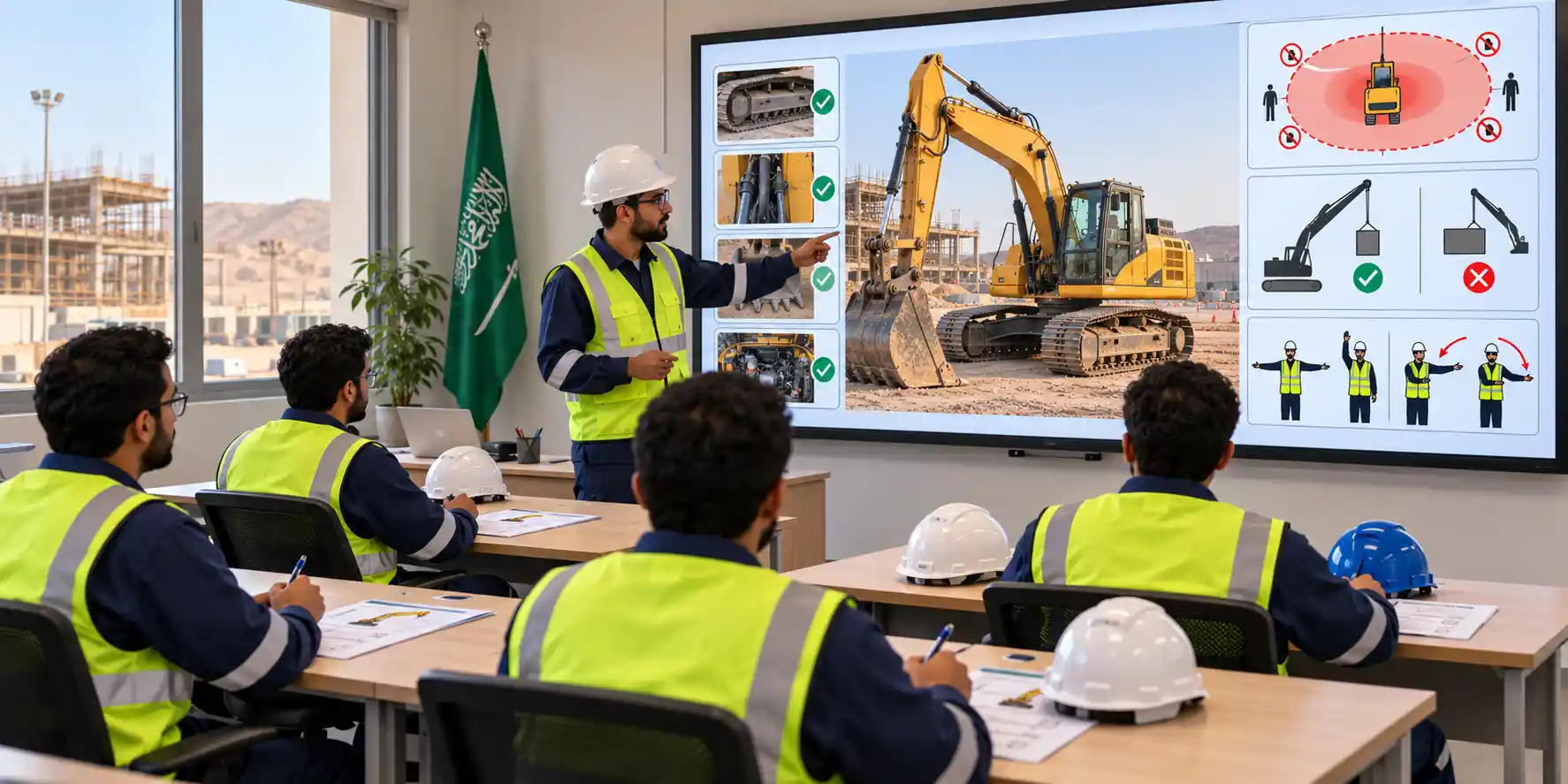
What This Course Covers, and What It Doesn’t
This is a theory and safety course. Trainees do not operate an excavator during it. Learning the controls well takes supervised seat time on a real machine, which your employer or site arranges once the safety basics are in place.
That split is deliberate. The classroom is the right place for the knowledge side: hazards, checks, load limits, signals and site rules. Train at our institute, or we bring the course to your location and run it for your whole crew in one go, which suits contractors with large groups to certify. Either way, new operators get the foundation before they climb in, and experienced ones get a structured refresh.
Who Should Attend
- Beginners and novice operators who want the safety grounding before their first supervised hours
- Experienced operators due a refresher or a certificate their client will accept
- Site supervisors who plan excavator work and set exclusion zones
- Banksmen, signallers and slingers who guide the operator and rig loads
- Maintenance personnel who carry out checks and repairs on earthmoving equipment
- Construction, oil and gas, and mining crews who work near excavators every day
- Apprentices starting out in plant operation
Excavator Training Across Saudi Arabia
Searching for an excavator training centre near me? Attend at our Al Khobar center in the Eastern Province, or have our trainers come to your project site anywhere in the Kingdom, from Riyadh and Jeddah to Jubail, Yanbu and remote mining areas. Training on site lets crews talk through the machines and ground conditions they actually work with. Classes run in Arabic, English, Hindi and Urdu.
Certificate, Validity and Verification
Complete the course and you receive a TVTC approved excavator training certificate, valid for 2 years. It carries a unique number in the format FVCAT-26-149967, and any employer can confirm it on our certificate verification page. When it is due, a short refresher renews your excavator training certification, so there is no need to repeat the full course.
Booking and Fees
Excavator training cost depends on group size and whether you train online, at our center or on site, so every booking gets its own quote. Contractors booking several crews, or more than one course, are quoted as a single package. Send us the number of trainees, your delivery choice and preferred dates.
- WhatsApp: +966 59 742 3196
- Call us: +966 59 742 3196
Excavator Operator Jobs in Saudi Arabia
Infrastructure, housing, oil and gas, and mining projects keep excavator operator jobs coming across the Kingdom. Employers want operators who can show both machine experience and safety training, and a verifiable certificate makes that second part easy to prove. Supervisors and banksmen benefit too, since many sites expect the whole team around the machine to be trained.
Saudi Standards and the Licence Question
Heavy equipment in the Kingdom is regulated by the Heavy Equipment Regulatory Center, set up within the Saudi Standards, Metrology and Quality Organization (SASO) by Council of Ministers Decision No. 488 in 2021. Its role includes setting the rules for qualifying and licensing heavy equipment operators and accrediting operator training bodies.
Our course is a TVTC approved safety course. It is not a SASO operator licence. Licensing requirements for excavator operators are still being rolled out, and they vary by employer and project, so confirm what your site requires with your employer or with SASO directly. Many contractors ask for a recognised safety certificate alongside proof of supervised machine experience, and that is where this course fits.