
Flagman Training in Saudi Arabia

One signal decides whether a reversing tipper stops a metre short of a trench or rolls into it. Our course
trains the person giving that signal, with live drills on the ground and a certificate at the end.

3 to 4 Hours | Centre, On Site or Online | Card Valid 2 Years | Arabic, English, Hindi, Urdu

What Is a Flagman?

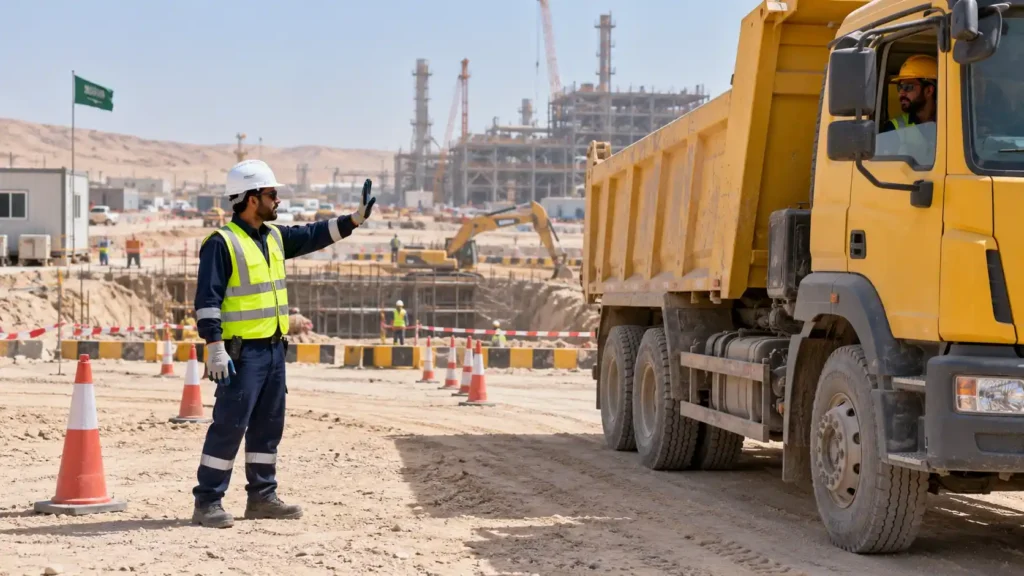
A flagman is the worker who controls how vehicles move around a work zone. They guide heavy machinery through tight spaces, direct drivers where signs alone won’t do, and stop collisions before they happen. When a dump truck backs toward an excavation and the operator can’t see the edge, the flagman is the operator’s eyes.

Our flagman training prepares workers for that job on Saudi sites: construction projects, oil and gas facilities, industrial plants, roadworks and busy logistics yards. Some people search for it as flag man training, others call it flagger or banksman training. The core skills are the same: the signals, where to stand, how to set out a safe zone, and what to do when things go wrong.
Flagman Training

Who Should Attend

  • Construction workers: often handed the flag with no warning.
  • Road crews: a lane closure is only as safe as the person controlling traffic past it.
  • Oil and gas crews: narrow access roads, heavy loads and strict movement rules.
  • Crane supervisors: a lift zone needs someone who can halt traffic straight away.
  • HSE officers: you can’t audit a traffic plan without knowing good flagging.
  • Warehouse and logistics staff: forklifts, trailers and pedestrians share the same yard.
  • Traffic marshals and banksmen: a formal course turns on-the-job habits into a recognised standard.
  • New site workers: learning the signals early beats learning them after a near miss.

Crews who also work near elevated platforms often pair this course with working at height training, while oil and gas teams usually add H2S training.

Eleven modules. Theory stays short, and every skill is practised before it is assessed.

What a flagman owns, who they report to, and their authority to stop any vehicle. Trainees learn where the duty starts and ends, so nobody assumes someone else is watching.

The heart of the course. Trainees learn the standard flag positions and the hand signals used to guide plant, in line with recognised flagger signalling standards (e.g. OSHA 1926.201). Each one is drilled until it reads clearly from a distance.

Signal

How it is given

What the driver does

STOP (flag)

Flag held straight out across the lane, free hand raised, palm to driver

Brings the vehicle to a full stop

ALERT (flag)

Flag held out, moved slowly up and down

Slows down and watches for workers ahead

GO (flag)

Flag lowered to the side, free hand waves the driver through

Moves off slowly past the work zone

Stop (hand)

One arm raised high, palm toward the driver

Stops and holds position

Move ahead

Both palms facing the flagman, beckoning toward the body

Drives slowly toward the flagman

Reverse

Both arms forward, palms facing out, pushing motion

Reverses slowly

Turn left or right

Arm held straight out, pointing the way to turn

Steers in the direction shown

Slow down

Arm out to the side, palm down, moved gently up and down

Reduces speed

Distance closing

Palms facing, gap narrowed as the vehicle nears its mark

Creeps forward and stops when palms meet

Emergency stop

Both arms stretched out and waved

Stops immediately

Signal codes can vary between sites, so trainees also learn to agree the signals with each driver before work starts.

Advance warning signs, cone tapers, barriers and diversion routes. Trainees lay out a zone, then check it as a driver would see it.

Signs, cones, delineators, barriers, flashing lights and stop and slow paddles. What each device tells a driver, where it goes, and when it backs up a person rather than replacing one.

Trucks, loaders, excavators and cranes all have areas the operator cannot see. Trainees map them and practise working outside them.

High visibility clothing, hard hat, boots, gloves and eye protection, plus staying visible at dawn, dusk and after dark.

Radio procedure, clear call words and reading back each message, plus eye contact with drivers and handling one who ignores a signal.

Reflective gear at night, low visibility in dust, sun glare, and rotating posts in summer heat without leaving the zone uncovered.

What to do if a vehicle breaks into the zone, a worker is struck or a fire starts.

Spotting danger early: speeding drivers, fatigue, poor signage, pedestrians crossing, and standing in the line of fire.

A written theory test, then a practical skills evaluation in which each trainee controls traffic through a simulated work zone. Pass mark 70%.

Flagman vs Banksman vs Traffic Marshal

These roles overlap, and the job title often depends on the employer.

Role

Main focus

Typical setting

Flagman

Frontline control of vehicle movement at the edge of a work zone, stopping and releasing traffic

Roadworks, site gates, lane closures

Banksman

Guiding vehicles and plant while reversing, loading or lifting. The term used in Europe and widely on Saudi sites for the same family of work

Construction sites, yards, crane lifts

Traffic marshal

Managing traffic across a whole site, including pedestrian routes and crossings

Large projects, plants, logistics hubs

Employers use these titles interchangeably. What matters is the skill set, and this course builds the shared skills behind all three.

Saudi Work Zones: Why Local Training Matters

A flagger course built on a foreign template misses what Saudi sites demand. Road work here falls under the Saudi Roads Code, the Roads General Authority’s national reference for traffic engineering and road safety. On top of that, the same stretch of road can carry heavy trucks, tankers, private cars and pedestrians at once. Then there’s the climate. Heat wears people down, dust cuts visibility in minutes, and low sun can hide a hand signal. Aramco-vendor sites also expect documented training and valid certificates for anyone controlling traffic.

Our trainers prepare crews for real Eastern Province conditions, from project roads around Dammam to the industrial corridors of Jubail. For a wider view of what Saudi sites expect, read our guide to safety courses in Saudi Arabia.

Why Train With Future Institute
why choose us

TVTC

a TVTC-approved training center and ISO 9001:2015 certified, so your crew’s certificate holds up when an auditor checks it. See more courses on our TVTC courses page.
We teach in Arabic, English, Hindi and Urdu, where most Saudi providers offer two at most. Train in one of our six rooms at Al Khuzayem Trade Center 2, Al Khobar, or at your site anywhere in the Kingdom, on dates that fit your shifts. We have 134+ Google reviews.

rating

4.9/5.0

Rating

icon 3

100+

Workers

12+ Years

Experience

Frequently Asked Questions

A flag man, or flagman, is the worker who controls vehicle movement around a work zone. They guide heavy machinery, direct drivers past hazards and prevent collisions where signs alone are not enough. The full syllabus is set out in What You Will Learn above.

A flagman directs vehicles through and around the work area and controls who goes in and out. They guide drivers near plant, trenches and excavations, warn of hazards, and keep traffic moving safely through diversions. They stay in touch with operators and supervisors by radio or signal.

A flagman handles frontline movement control at the edge of a work zone. A banksman guides vehicles and plant during reversing, loading and lifts, a term common in Europe and on Saudi sites. A traffic marshal looks after traffic across a whole site, including pedestrians. The titles overlap a lot, so focus on the skill set rather than the label.

The course takes 3 to 4 hours, covering the theory sessions, the practical drills and the final assessment. For on-site groups we can plan the dates around your shift pattern, so the crew isn’t pulled off the job for longer than needed.

Your certificate is valid for [2 years]. Before it expires, a short refresher course renews it, so there is no need to repeat the full course. Each certificate carries a unique number, and employers can confirm its status at any time on our certificate verification page.

Yes. We teach the course in Arabic, English, Hindi and Urdu. Mixed crews can train in a language each worker fully understands, which matters when a misread signal can cost a life. The Hindi and Urdu options are rare among Saudi providers.

Future Institute is a Saudi Aramco approved vendor, E-Reference No. 0015955, and our certificates are recognised by employers across the Kingdom. The certificate is issued under TVTC and carries a unique number any employer can check online.

Book Your Flagman Training

Tell us the course, how many trainees you have and your preferred dates, and we’ll send you a price. We can run flagman training at our center or at your site anywhere in Saudi Arabia.